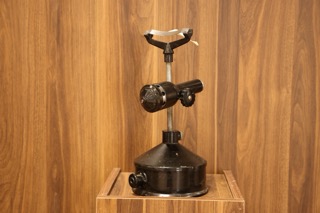
مطياف
Spectroscope
الوصف التفصيلي للمقتنى
تعرف على تاريخ وأهمية هذه القطعة الأثرية
المطياف المنشوري هو جهاز بصري يُستخدم لتحليل الضوء إلى مكوناته الطيفية المرئية، اعتمادًا على خاصية انكسار الضوء عند مروره عبر منشور زجاجي. ويُعد من أقدم أدوات التحليل الطيفي التي استُخدمت في الفيزياء. مبدأ العمل يعتمد الجهاز على تمرير شعاع ضوئي عبر شق ضيق، ثم توجيهه إلى منشور يقوم بتفريق الضوء إلى ألوانه المختلفة نتيجة اختلاف معاملات الانكسار باختلاف الأطوال الموجية. بعد ذلك تُرصَد الألوان المفصولة باستخدام عدسة رؤية أو تلسكوب صغير مزود بتدريج زاوي. المكونات الرئيسية مصدر ضوء (طبيعي أو مصباح طيفي). شق ضيق لضبط عرض الشعاع الضوئي. عدسة موازاة (Collimator). منشور زجاجي قابل للدوران. تلسكوب أو عدسة رؤية لقراءة الطيف. تدريج زاوي لقياس زوايا الانكسار. الاستخدامات تحليل الأطياف الضوئية للعناصر والمواد. دراسة قوانين الانكسار والتشتت اللوني. قياس الأطوال الموجية للضوء. التجارب التعليمية في معامل الفيزياء بالمدارس والجامعات. الأهمية العلمية والتاريخية مثّل هذا الجهاز خطوة أساسية في تطور علم التحليل الطيفي، وأسهم في فهم طبيعة الضوء وبنية المادة، وكان أساسًا لتطور أجهزة أكثر دقة مثل مطياف الحيود والمطيافات الحديثة المستخدمة في الفيزياء والكيمياء والفلك. القيمة المتحفية يُعد المطياف المنشوري قطعة تعليمية وتاريخية مهمة، تعكس تطور أدوات القياس العلمي في أواخر القرن التاسع عشر وبدايات القرن العشرين، ودور المعامل التعليمية في نشر العلوم الحديثة.
Prism Spectrometer The prism spectrometer is an optical instrument used to analyze light into its visible spectral components, based on the principle of light refraction as it passes through a glass prism. It is considered one of the earliest tools used in spectral analysis in physics. Principle of Operation The device works by passing a beam of light through a narrow slit, which is then directed toward a prism. The prism disperses the light into its constituent colors due to differences in refractive indices for different wavelengths. The separated colors are then observed using a viewing lens or a small telescope equipped with an angular scale. Main Components Light source (natural light or a spectral lamp). Narrow slit to control the width of the light beam. Collimator lens. Rotatable glass prism. Telescope or viewing lens for observing the spectrum. Angular scale for measuring angles of refraction. Uses Analysis of optical spectra of elements and materials. Study of the laws of refraction and chromatic dispersion. Measurement of light wavelengths. Educational experiments in physics laboratories at schools and universities. Scientific and Historical Significance This instrument represented a fundamental step in the development of spectroscopy, contributing to the understanding of the nature of light and the structure of matter. It laid the foundation for more precise instruments such as diffraction spectrometers and modern spectroscopic devices used in physics, chemistry, and astronomy. Museum Value The prism spectrometer is an important educational and historical artifact, reflecting the evolution of scientific measurement tools in the late nineteenth and early twentieth centuries, and the role of teaching laboratories in the dissemination of modern science.
Spectromètre à prisme Le spectromètre à prisme est un instrument optique utilisé pour analyser la lumière en ses composantes spectrales visibles, en s’appuyant sur le principe de la réfraction de la lumière lors de son passage à travers un prisme en verre. Il est considéré comme l’un des premiers outils d’analyse spectrale utilisés en physique. Principe de fonctionnement L’appareil fonctionne en faisant passer un faisceau lumineux à travers une fente étroite, puis en le dirigeant vers un prisme. Celui-ci disperse la lumière en différentes couleurs en raison de la variation des indices de réfraction selon les longueurs d’onde. Les couleurs séparées sont ensuite observées à l’aide d’une lunette ou d’un petit télescope muni d’un cercle gradué. Composants principaux Source lumineuse (lumière naturelle ou lampe spectrale). Fente étroite pour régler la largeur du faisceau lumineux. Collimateur. Prisme en verre orientable. Lunette ou système d’observation du spectre. Cercle gradué pour mesurer les angles de réfraction. Utilisations Analyse des spectres optiques des éléments et des matériaux. Étude des lois de la réfraction et de la dispersion chromatique. Mesure des longueurs d’onde de la lumière. Expériences pédagogiques dans les laboratoires de physique des écoles et des universités. Importance scientifique et historique Cet instrument a constitué une étape majeure dans le développement de la spectroscopie. Il a contribué à la compréhension de la nature de la lumière et de la structure de la matière, et a servi de base au développement d’instruments plus précis, tels que les spectromètres à réseau et les dispositifs spectroscopiques modernes utilisés en physique, en chimie et en astronomie. Valeur muséale Le spectromètre à prisme est une pièce éducative et historique importante, illustrant l’évolution des instruments de mesure scientifique à la fin du XIXᵉ et au début du XXᵉ siècle, ainsi que le rôle des laboratoires d’enseignement dans la diffusion des sciences modernes.